
It along our ditches, covering the abandoned parts of our gardens, proliferates generously in early spring in the fall, providing it is at his feet a little moisture for food - nettle , feared for its leaves urticairiantes is appreciated by connoisseurs for its virtues of plants preventive, curative, nutritional and ... buds! Maghreb widespread in northern Europe, nettle is without doubt one of the most useful plants, and easy to integrate in everyday life, as "simple" (the name by which it has long been designated plants), such as food because it is a veritable treasure of nature in nutrition ...
Its Latin name, Urtica Rens, reminds us that it is recognizable to small vesicles that it shows very irritating on contact with its leaves. However, if we faint of protecting themselves from its clutches today, know that our ancestors did not hesitate to flog in the lower component, each spring, a beautiful bouquet of nettle, to treat circulatory problems, rheumatism, and asthenia. For sure, "the urtication" (for so they called this process), it will whip the blood, and awakens the energy!
It is rich in chlorophyll , organic acids, potassium nitrate and sodium, trace elements, many of which iron and sulfur, magnesium, silicon, as well as vitamins A, C and E. Its leaves are
diuretics and promote regulation of acidity in the body because they drain the urea and uric acid, thus relieving many inflammatory disorders. However, unlike other diuretic herbs, she makes an outstanding contribution to the remineralization, particularly in cases of iron deficiency.
Its most common uses involve skin and hair : it uses internally, or applied externally: in cases of acne, or eczema. It also gives good results in chronic skin diseases, as some psoriasis. It is known to treat cosmetic problems of greasy hair, and falls, especially when they are linked to blood disorders, as in cases of anemia. Nettle has a purifying action and support on these two tissues, plasma and blood, linked to the balance of the skin. It is useful in case of small hemorrhages, or bleeding gums. It was long used to combat gout, and all disorders related to water metabolism.
A food and drink: Uses
Nettle is used as well as infusion, decoction, maceration, poultice, following the system or specific tissue to be treated. The fresh nettle remains the source most interesting because it can combine with food or substitute other foods for a mono-diet for a few days (because unlike many substances or foods, it provides for the the essential needs of the body and make you a nice energy and a flawless skin).
For those who live in town, there are two interesting shapes you can to dispose of its virtues: the dried leaf (herbalist) or the juice e (now proposed by the store brand Salus bio).
 Nettles, the detox in style
For a small cure "Detox" springtime, nettle is probably the most interesting purifying plants, especially for those who suffer from chronic fatigue because it drains without draining your energy, quite the contrary. It promotes elimination, is very useful for people in the spring of disposal problems related to digestion (gazs, transit, red) as the circulatory system.
It will be very useful for people suffering from chronic skin problems and has, moreover, a balancing action for oily skin, as on the scalp fat.
Its action on hair growth, or preventing their fall is fairly well known. In short, who wants a makeover, and health, should sincerely consider a collection of nettles.
Last but not neglect, nettle is a "vegetable" delicious green, including the various components present in the leaves give flavor to your plate "meat" (!)... In these times of crisis, let us take advantage of what we produce good slopes and ditches! Little trick to avoid being bitten: pluck them while holding your breath ...
Credit flickr Kristian Baker, HiitaKireet
It is rich in chlorophyll , organic acids, potassium nitrate and sodium, trace elements, many of which iron and sulfur, magnesium, silicon, as well as vitamins A, C and E. Its leaves are
diuretics and promote regulation of acidity in the body because they drain the urea and uric acid, thus relieving many inflammatory disorders. However, unlike other diuretic herbs, she makes an outstanding contribution to the remineralization, particularly in cases of iron deficiency.
Its most common uses involve skin and hair : it uses internally, or applied externally: in cases of acne, or eczema. It also gives good results in chronic skin diseases, as some psoriasis. It is known to treat cosmetic problems of greasy hair, and falls, especially when they are linked to blood disorders, as in cases of anemia. Nettle has a purifying action and support on these two tissues, plasma and blood, linked to the balance of the skin. It is useful in case of small hemorrhages, or bleeding gums. It was long used to combat gout, and all disorders related to water metabolism.
A food and drink: Uses
Nettle is used as well as infusion, decoction, maceration, poultice, following the system or specific tissue to be treated. The fresh nettle remains the source most interesting because it can combine with food or substitute other foods for a mono-diet for a few days (because unlike many substances or foods, it provides for the the essential needs of the body and make you a nice energy and a flawless skin).
For those who live in town, there are two interesting shapes you can to dispose of its virtues: the dried leaf (herbalist) or the juice e (now proposed by the store brand Salus bio).
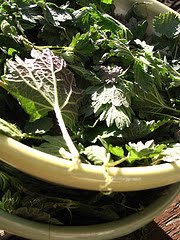 Nettles, the detox in style
 For a small cure "Detox" springtime, nettle is probably the most interesting purifying plants, especially for those who suffer from chronic fatigue because it drains without draining your energy, quite the contrary. It promotes elimination, is very useful for people in the spring of disposal problems related to digestion (gazs, transit, red) as the circulatory system.
It will be very useful for people suffering from chronic skin problems and has, moreover, a balancing action for oily skin, as on the scalp fat.
Its action on hair growth, or preventing their fall is fairly well known. In short, who wants a makeover, and health, should sincerely consider a collection of nettles.
Last but not neglect, nettle is a "vegetable" delicious green, including the various components present in the leaves give flavor to your plate "meat" (!)... In these times of crisis, let us take advantage of what we produce good slopes and ditches! Little trick to avoid being bitten: pluck them while holding your breath ...
Credit flickr Kristian Baker, HiitaKireet


